Hartford Commercial Roofing FAQ
Straight Answers on Membranes, Metal, Snow, and Permits
This Hartford commercial roofing FAQ answers what building owners ask about systems, cost drivers, replacement, Connecticut weather, permits, and service towns.
Hartford Commercial Roofing FAQ by Topic
The Hartford commercial roofing FAQ below is grouped into eight topics. Answers for Hartford building owners and facility managers on flat and metal commercial roofs: which system fits, what moves the price, how Connecticut weather and permits shape the work, and how we handle different building types.
Services
What flat roofing systems does a Hartford commercial roofing contractor install?
We install single-ply TPO and EPDM membranes on flat and low-slope commercial roofs, plus commercial metal roofing on sloped buildings and industrial roofing for plants. Each flat roof job includes insulation, cover board where needed, flashing at walls and curbs, and edge metal. The right system depends on the deck, drainage, rooftop equipment, and how the building is used.
What is TPO roofing, and is it used on Hartford commercial buildings?
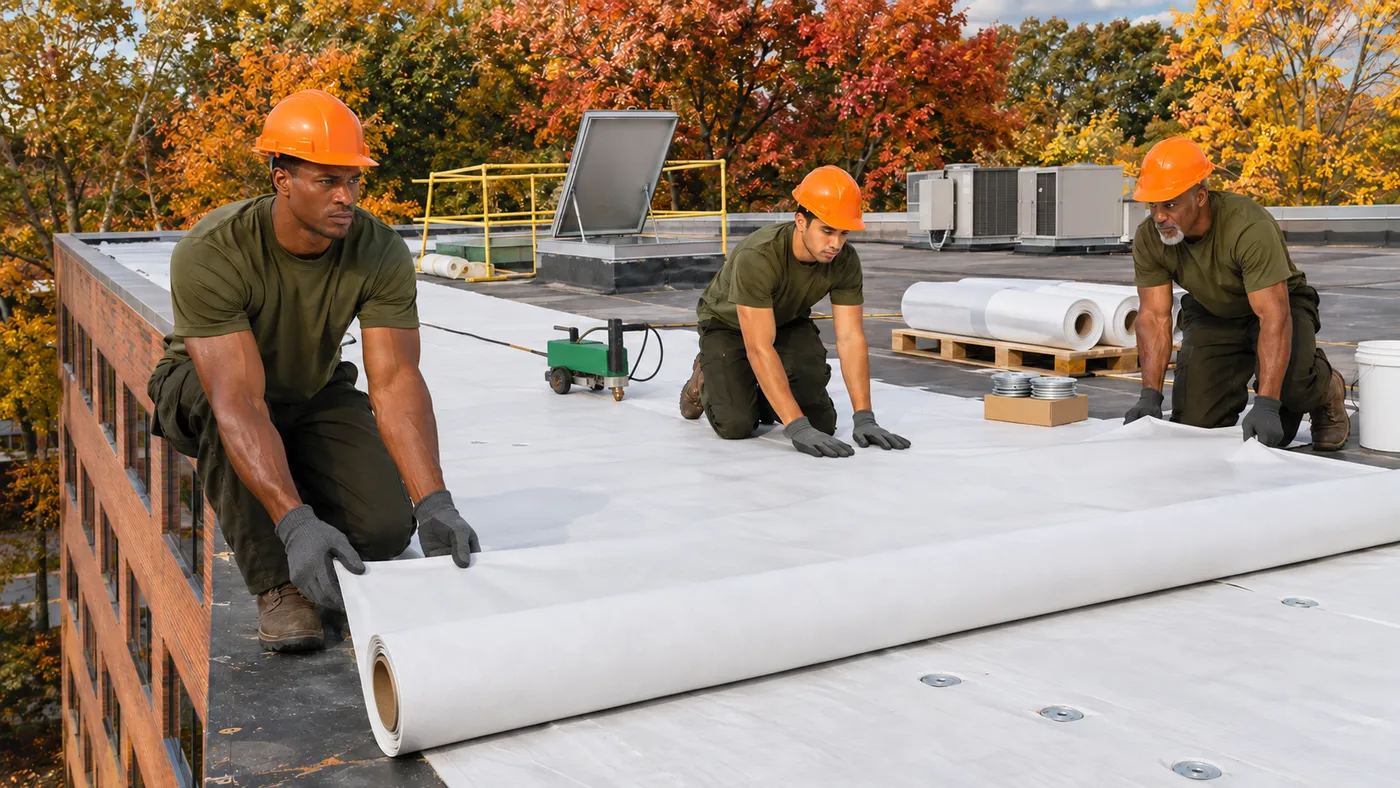
TPO is a white or light-colored single-ply membrane whose seams are heat-welded with hot air into one continuous sheet. It is common on Hartford warehouses, retail buildings, and offices with flat or low-slope roofs. We install it mechanically fastened or fully adhered over insulation, and the welded seams and light surface are its main draws.
What is EPDM roofing, and where does it fit on Hartford buildings?
EPDM is a synthetic rubber membrane, usually black, that stays flexible in cold weather. It fits flat roofs on offices, schools, churches, and older masonry buildings where large sheets can cover the roof with few seams. We install it fully adhered, mechanically attached, or ballasted, with seams joined by tape and primer.
What does industrial roofing cover for Hartford manufacturing plants?
Industrial roofing covers the large, equipment-heavy roofs on plants, shops, and processing buildings. We install membrane or metal systems sized to the building, with flashing at exhaust stacks, vents, and curbs and walkway pads where crews service equipment. Work is planned around production schedules and safety rules on site.
Do you install, repair, and maintain commercial metal roofs in Hartford?
Yes. We install new standing-seam and exposed-fastener metal roofs, repair leaking laps, fasteners, and flashing, and run maintenance checks on existing metal roofs. Maintenance covers fastener tightening, sealant renewal, gutter and trim checks, and clearing debris that holds water against the panels.
How do you handle roofing around rooftop equipment on Hartford industrial buildings?
Rooftop units, exhaust fans, and pipe racks are where most roofs fail, so we treat them as their own work zones. We flash each curb and penetration to the membrane manufacturer's details, raise low curbs where needed, and add walkway pads on service routes. We coordinate with mechanical contractors when units must be lifted or disconnected.
Cost
What drives commercial roofing cost per square foot in Hartford?
Cost per square foot comes down to the roof system, total area, and what is under the old roof. Deck repairs, wet insulation found by core cuts, the number of tear-off layers, flashing at curbs and walls, and crane or lift access all move the price. Large, open roofs usually cost less per square foot than small, cut-up ones.
What changes TPO roofing cost on a Hartford flat roof?
TPO pricing depends on membrane thickness, whether the sheet is mechanically fastened or fully adhered, the insulation thickness required, and the number of penetrations to flash. Tear-off of existing layers and replacement of wet insulation add labor. Tapered insulation to fix ponding also adds material, but it often solves a drainage problem at the same time.
What affects EPDM roofing cost in Connecticut?
EPDM cost depends on the attachment method, sheet thickness, insulation, and how many seams and penetrations the roof has. Ballasted systems need a structure that can carry the stone, while fully adhered systems take more adhesive and labor. Old roof removal, deck repairs, and access for hoisting materials also factor into the price.
How much is a commercial metal roof in Hartford, and what sets the price?
We price each metal roof after a site visit because the variables are large. Panel type (standing seam or exposed fastener), metal gauge and finish, roof area and pitch, trim and flashing details, removal of the old roof, and purlin or deck repairs all set the number. Retrofit framing over an existing flat roof adds its own cost.
What goes into commercial roof replacement cost for a Hartford building?
Replacement cost covers tear-off and disposal, deck repair, new insulation and cover board, the new membrane or metal roof, and all flashing, edge metal, and curb work. Core cuts show how much wet insulation must come out. Access, crane time, phased work around tenants, and the number of rooftop units also shape the price.
Systems and Lifespan
TPO vs EPDM: which fits a Hartford commercial roof?
Both work well on flat roofs; the choice depends on the building. TPO's heat-welded seams and light surface suit roofs with many penetrations and owners who want a reflective roof. EPDM's flexibility in cold weather and large sheets suit roofs with few interruptions. Deck type, existing insulation, and rooftop equipment usually settle it on site.
Can a TPO roof last 30 years in Connecticut?
No roof comes with a set number of years. A TPO roof's service life depends on membrane thickness, weld quality, drainage, foot traffic, and how quickly small punctures and flashing issues get fixed. Thicker membranes, tapered insulation that ends ponding, walkway pads, and regular inspections all help a TPO roof hold up through Connecticut winters and summers.
What affects the lifespan of an EPDM roof in Hartford?
Seam condition, flashing details, drainage, and rooftop traffic matter most. EPDM itself resists cold and sunlight well, but taped seams and flashings at curbs and walls are where it usually fails first. Ponding water, debris at drains, and dropped tools during equipment service shorten its life. Routine inspections catch seam and flashing problems early.
What are the downsides of TPO roofing in a Connecticut climate?
TPO can be punctured by dropped tools and foot traffic, so service paths need walkway pads. Its seams must be welded correctly, which takes trained crews and the right weather conditions. Its light surface keeps the roof cooler in summer but adds little winter benefit. Over time the membrane surface weathers and needs inspection.
What are common problems with EPDM roofs on Hartford buildings?
The most common problems are seams that lift as adhesive or tape ages, shrinkage that pulls flashing away from walls and curbs, and punctures from foot traffic or debris. Black EPDM also absorbs summer heat. We repair seams and flashings with compatible tape and primer and replace sections where the sheet has torn.
Fully adhered vs ballasted EPDM: which suits a Hartford roof?
Fully adhered EPDM is glued to the insulation or cover board, giving a smooth surface that is easy to inspect and repair.
Ballasted EPDM is held down by stone and needs a roof structure rated for the extra weight, which matters under Connecticut snow loads. Where the structure has no spare capacity, an adhered or mechanically fastened system avoids that added load.
Standing seam vs exposed fastener metal roofs: which fits a Connecticut commercial building?
Standing-seam roofs hide their fasteners under raised seams and clips, so fewer holes pass through the panels and the metal can move with temperature swings. Exposed-fastener roofs cost less to install but rely on screws and washers that loosen and wear over time. Building use, slope, and budget usually decide which one fits.
What are the biggest problems with metal roofs in Hartford winters?
Thermal movement loosens fasteners and opens laps, ice and snow build up at eaves and valleys, and condensation forms under panels in unheated buildings. Snow sliding off steep metal can damage gutters and lower roofs. We address these with fastener replacement, sealed laps, snow guards where needed, and attention to ventilation and insulation.
What industrial roofing materials hold up on Hartford plants?
The right material depends on what the plant puts on its roof. Plants that vent oils, grease, or chemicals need a membrane rated for that exposure. Heavy service traffic calls for thicker membranes and walkway pads. Large metal buildings often stay metal. We review exhaust sources and equipment before recommending a system.
Roof Replacement
When should a Hartford building owner replace a commercial roof instead of repairing it?
Replacement makes sense when leaks keep returning in new places, insulation is wet across large areas, the membrane is brittle or shrinking, or the deck is damaged. If repairs would cover a large share of the roof, a new system is often the steadier choice. A roof inspection with core cuts shows which situation you are in.
Why do core cuts matter before replacing a Hartford flat roof?
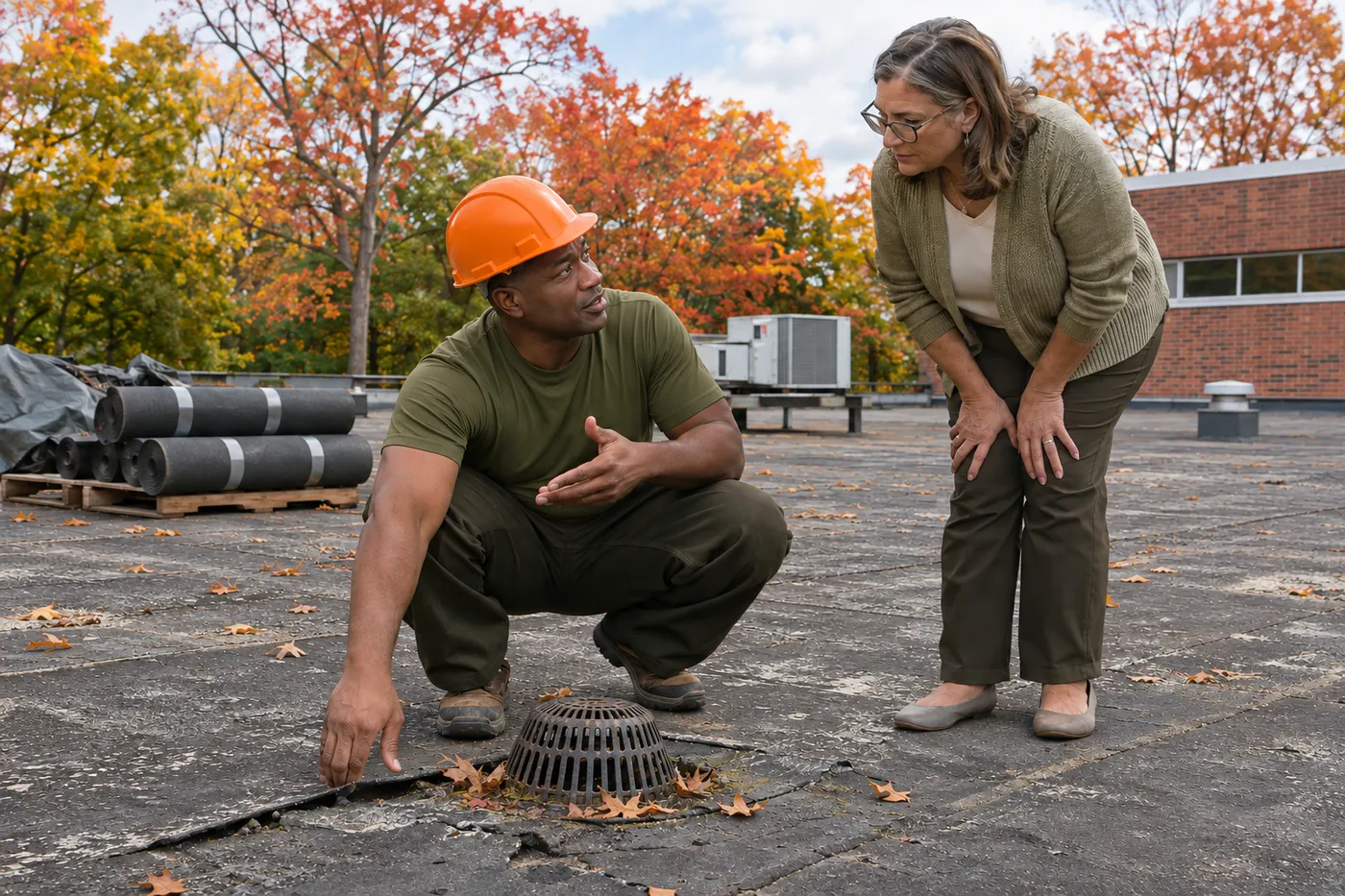
A core cut is a small sample taken through the roof layers down to the deck. It shows how many roofs are already on the building, what insulation is there, and whether it is wet. That tells us whether a full tear-off is needed and how much material will come out, which shapes both the scope and the price.
What happens during an industrial roof replacement in Hartford while the plant keeps running?
We replace the roof in sections, opening only as much as can be closed up before the crew leaves each day. Work zones are set away from intakes and process exhausts where possible, and we coordinate shutdowns of rooftop equipment with plant staff. Debris chutes, crane lifts, and material staging are planned around shipping areas and shift changes.
Your Question Is About Your Own Roof?
Some answers only come from standing on the roof. Call and we will set up a walk with core cuts.
Connecticut Weather
How does Hartford snow load factor into a commercial roof replacement design?
The 2022 Connecticut State Building Code lists Hartford's ground snow load at 30 pounds per square foot and sets design flat-roof snow loads at no less than 30 psf. Drifts against parapets, taller walls, and rooftop units add load in those spots. A replacement that adds weight or changes the roof profile should be checked against those loads.
How do ice dams at parapets and drains affect EPDM and TPO roofs in Hartford?
Snow melts during the day, runs toward parapets and drains, and refreezes overnight, blocking drainage. Water then backs up against wall flashings and seams that were never meant to sit underwater. We detail parapet flashing high enough to stay above that water, keep drains and scuppers clear, and use tapered insulation to move water to the outlets.
Can commercial roofing be installed in a Connecticut winter?
Some of it can. TPO welding and mechanically fastened systems tolerate cold better than adhesives, which have minimum application temperatures. Snow and ice must be cleared and the deck must be dry before any new roof goes down. For winter emergencies we can dry in a section and complete the full system when temperatures allow.
Permits and Codes
Does a commercial roof replacement in Hartford need a building permit?
Plan on one. Re-roofing does not appear on the 2022 Connecticut State Building Code's list of work exempt from permits (section 105.2), and that code applies to permit applications filed from October 1, 2022. In Hartford, the Licenses and Inspections division's Building and Trades team issues permits and checks work for code compliance. We confirm permit needs before scheduling.
Who reviews roofing permits and inspections in Hartford?
Hartford's Licenses and Inspections division reviews construction plans for code compliance and issues permits through its Building and Trades team. Its inspectors review projects at milestones and at substantial completion. The city also publishes a viewer for searching issued building permits and a schedule of permit fees.
Does adding insulation during a Hartford reroof trigger a structural check?
It can. Connecticut's amendment to the existing building code (section 304.1.1) requires members that carry snow loads to meet current design loads when a reroofing permit is needed. Exceptions include roofs with no net increase in insulation R-value, buildings designed under the 1978 or later state codes, and buildings an engineer confirms can carry the design loads.
Building Types
What commercial roofing works on Hartford brick office buildings?
Many older brick office buildings have flat roofs behind parapet walls, so the flashing up those walls matters as much as the membrane. Common choices are adhered EPDM or TPO over new insulation, with counterflashing set into the masonry and coping metal on top. Crane lifts and staging are planned around tight downtown sidewalks and tenant entrances.
What roof systems suit Hartford interstate warehouses?
Large warehouse roofs usually call for mechanically fastened TPO or EPDM over rigid insulation, laid out to keep the seam count low and drainage moving to the drains. We phase the work so docks and storage stay open, and flash skylights, rooftop units, and exhaust fans to the manufacturer's details.
Do you install metal roofing for agricultural and farm buildings near Hartford?
Yes. We install and repair commercial metal roofing on barns, equipment sheds, and farm storage buildings in the towns around Hartford. Exposed-fastener panels are common on these buildings, and we pay close attention to fastener spacing, trim, and ventilation so condensation does not drip on stored equipment or feed.
What roofing do Hartford bus garages and fleet buildings need?
Garage roofs see exhaust, heat, and moisture from below and heavy equipment service on top. We install systems with well-flashed exhaust stacks and vents, walkway pads to rooftop units, and insulation that limits condensation. Work is scheduled around vehicle movement so the garage keeps operating.
Service Areas
What should West Hartford property owners know before a commercial roof replacement?
We serve West Hartford, and every replacement there starts with an inspection and core cuts to set the scope. Owners should plan for a building permit, staging space for materials and debris, and a schedule that keeps storefronts, offices, and parking open. We walk through all of that before work begins.
Do you install TPO and EPDM roofs on East Hartford commercial buildings?
Yes. We serve East Hartford and install TPO and EPDM membranes on warehouses, offices, retail buildings, and industrial properties there. Each roof gets the system that fits its deck, drainage, and rooftop equipment, with flashing and edge metal detailed for Connecticut winters.
Can you put a new metal roof on a Glastonbury commercial or farm building?
Yes, Glastonbury is in our service area. We install standing-seam and exposed-fastener metal roofs on commercial buildings, barns, and storage buildings in town, and repair and maintain existing metal roofs as well. Panel choice depends on the building's use, slope, and budget.
Do you handle commercial roofing for Wethersfield businesses?
Yes. We serve Wethersfield with flat roof installation and replacement, commercial metal roofing, and roof work on industrial buildings. Whether the building is a strip center, an office, or a shop, the job starts with an on-site inspection so the scope matches the roof's actual condition.
Do you replace flat roofs on South Windsor warehouses and industrial buildings?
Yes. We serve South Windsor and replace flat roofs on warehouses, light industrial buildings, and offices there. Large roofs are replaced in sections so operations continue, with new insulation, membrane, and flashing at every curb and drain. Core cuts at the start show how much of the old roof must come off.
Do you serve Bloomfield, Blue Hills, Windsor, Avon, Simsbury, Weatogue, Windham, Bolton, Salem, and Barkhamsted?
Yes, we provide commercial roofing in all of these towns. The state code lists a 35 psf ground snow load for Avon, Simsbury, and Barkhamsted, compared with 30 psf in Hartford, which we account for in roof design there. If your building is outside these towns, call us or send a message and we will let you know.
Not in the Hartford Commercial Roofing FAQ? Ask Us
Call with your question or request a roof walk. We answer on the phone what we can and inspect the rest.